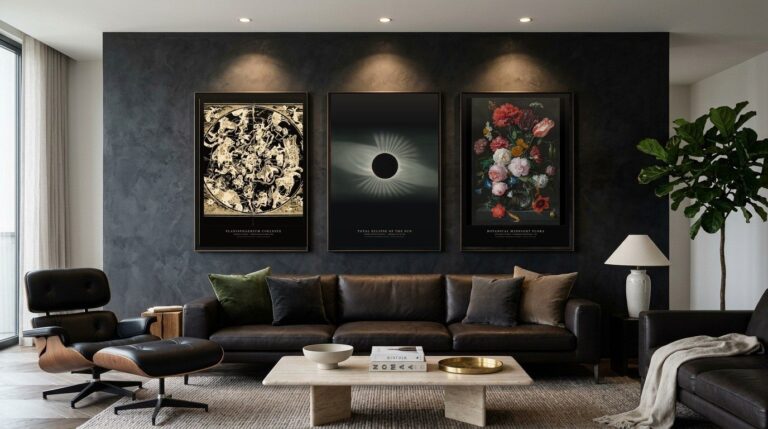
When art patrons invest in limited-edition archival curations, their attention is almost exclusively drawn to the subject matter: the dramatic astrological constellations of a seventeenth-century celestial sphere, the botanical geometry of Dutch Baroque flora, or the sweeping crests of Japanese ukiyo-e woodblocks. Yet in spatial architecture and residential curation, artwork never exists in a void. It exists in an ambient envelope of photons.
Lighting is the silent co-author of every print hanging on your walls. A masterwork that appears breathlessly atmospheric on a backlit smartphone screen can transform into an illegible sheet of blinding glare when illuminated by an afternoon south-facing window. Conversely, a rich, dark celestial star chart displayed beneath dim accent halogens can lose its deepest tonal nuances if the surface finish fails to reflect ambient light effectively. Understanding the physics of finish selection—specifically the deliberate choice between Anti-Glare Matte BOPP and Radiant High-Gloss BOPP—is the most decisive curatorial decision you will make for your home.
“Lighting is the silent co-author of visual art. A print does not merely depict an image; it interacts continuously with the angle, Kelvin temperature, and intensity of the photons in your room.”
1. The Polymer Chemistry: What is BOPP Thermal Lamination?
Before analyzing optical physics, one must understand the substrate substrate chemistry that sets Celestial Yak prints apart from commodity commercial paper. Most consumer art posters sold online are printed on raw 170–220 GSM coated art paper with liquid water-based varnishes or unprotected digital ink. When exposed to Indian humidity cycles—from coastal monsoon deluges to dry desert summers—these unprotected fibers absorb atmospheric moisture, resulting in unsightly edge curling, paper waviness (cockling), and irreversible color oxidation.
Celestial Yak utilizes an industrial standard known as BOPP (Biaxially Oriented Polypropylene) thermal lamination. In this specialized process, a pure polypropylene film is extruded and stretched mechanically in two perpendicular directions (machine direction and transverse direction). This biaxial molecular orientation aligns the polymer chains into a crystalline grid, bestowing remarkable tensile strength, high dimensional stability, complete water impermeability, and unmatched optical clarity.
During our finishing stage in our Jaipur and Delhi ateliers, this micro-gauge BOPP film is fusion-bonded onto both faces of our archival 300 GSM heavyweight art cardstock using heated steel rollers operating at precisely 110°C under high mechanical nip pressure. The heat-activated polymer adhesive melds irrevocably into the cellulose paper matrix. The result is a non-porous, airtight shield that locks out ambient moisture, resists fingerprint grease, and guarantees that our 13×19″ prints remain perfectly flat for decades without buckling or fading.
2. Anti-Glare Matte BOPP: Micro-Surface Light Dispersion
Anti-Glare Matte BOPP is the connoisseur’s choice for spaces characterized by abundant daylight, expansive glass windows, or bright overhead fixtures. Its exceptional performance stems from micro-surface engineering. While appearing completely smooth and velvety to human fingertips, the surface of Matte BOPP features microscopic undulating peaks and valleys at the sub-micron scale.
When incident light rays strike this micro-textured barrier, they do not bounce back in a uniform direction (which would create specular glare or a visible reflection of the light bulb). Instead, the photons are scattered symmetrically in all directions—a phenomenon known in optics as Lambertian diffuse reflection.
Advantages of Anti-Glare Matte BOPP:
- Zero Specular Reflection: Eliminates harsh mirror reflections of overhead ceiling LEDs, ring lights, track spots, or sunlit window panes. The artwork remains 100% visible from every viewing angle.
- Soft Tactile Velvet Feel: The exterior imparts a gentle, tactile drag reminiscent of fine museum book jackets and archival cotton etching paper.
- Suppression of Fingerprint Residue: The diffuse micro-texture naturally hides natural skin oils, making it resilient to accidental handling during unframed inspection or mounting.
- Preservation of Tonal Subtlety: In artworks dominated by mid-tones, architectural sketches, and soft parchment textures (such as antique botanical charts), Matte BOPP avoids harsh glare hot spots, preserving the delicate vintage aesthetic.
3. Radiant High-Gloss BOPP: Dynamic Range & $D_{\text{max}}$ Saturation
Radiant High-Gloss BOPP approaches optical physics from the inverse objective: the pursuit of maximum specular transmission and uncompromising optical density ($D_{\text{max}}$). Unlike matte film, the surface of High-Gloss BOPP is cooled rapidly against a mirror-polished chrome roller, yielding a glassy, perfectly planar surface with zero micro-roughness.
Because there are no surface irregularities to scatter light internally, incident light penetrates directly through the transparent polymer film, strikes the 12-color archival pigment layer beneath, and reflects back through the film with near-zero optical diffusion.
The Science of $D_{\text{max}}$:
In photographic science, $D_{\text{max}}$ denotes the maximum optical density (black point) that a printing medium can achieve. When ambient light strikes an unlaminated or poorly finished dark surface, light scattering lightens the perceived black to a dark charcoal. High-Gloss BOPP acts as a refractive lens, creating an optical liquid immersion effect. Black backgrounds (such as deep cosmic voids or deep midnight hues) appear dramatically darker, deeper, and richer, while vibrant reds, blues, and gold chromolithograph pigments leap forward with liquid brilliance.
Advantages of Radiant High-Gloss BOPP:
- Maximized Color Vibrancy: Colors appear noticeably more saturated and punchy, matching the glowing clarity of illuminated display monitors.
- Deep Cosmic Obsidian Blacks: Star maps and night compositions achieve ink-like obsidian depths that draw the eye into the infinite distance of the artwork.
- Spectacular Under Directional Accent Lights: Under warm recessed ceiling spots or dim evening lamps, the high-gloss surface casts luxurious specular highlights that announce the print as a focal conversation centerpiece.
4. The Architectural Lighting Decision Matrix
To eliminate guesswork when curating your living space or corporate office, the Celestial Yak Spatial Architecture team has formulated this definitive lighting decision matrix:
| Room Lighting Condition | Light Physics Behavior | Recommended BOPP Finish | Curatorial Rationale |
|---|---|---|---|
| South or West Daylight (Floor-to-Ceiling Windows) | High-intensity direct sunlight (5,000–10,000 Lux), intense directional beam. | Anti-Glare Matte BOPP | Gloss will create a blinding mirror glare. Matte scatters the sunlight and preserves full artwork visibility. |
| North Daylight / Skylights (Indirect Studio Light) | Soft, diffused natural daylight (500–1,500 Lux), zero harsh shadow edges. | Either (Matte or Gloss) | North light is naturally diffuse; Gloss delivers rich contrast without excessive glare; Matte offers museum-grade tranquility. |
| Living Room Evening Ambient (2700K Warm Halogen / Lamps) | Low-angle, warm incandescent glow (100–300 Lux), high amber spectrum. | Radiant High-Gloss BOPP | Gloss brings dark star maps alive under moody floor lamps, bouncing warm amber highlights across the glass-like face. |
| Modern Office / Studio (4000K Neutral LED Panels) | Overhead high-frequency LED troffers (500 Lux), sharp downward cones. | Anti-Glare Matte BOPP | Direct ceiling LEDs reflect as bright white circles on high-gloss prints; Matte diffuses the LED reflections completely. |
| Dedicated Art Track Spots (3000K Narrow Beam at 30°) | Museum-standard 30-degree ceiling track spotlight aimed at frame center. | Radiant High-Gloss BOPP | At 30 degrees, specular reflection bounces downward to the floor away from standing eye level, leaving pure vibrant pigment depth. |
5. Tactile Resilience, Maintenance & Museum Care
A common anxiety among fine art collectors is cleaning and maintenance. Traditional unlaminated art prints or watercolors framed without glass cannot be dusted or touched without causing permanent abrasion to the fragile paper grain. Even a single moisture drop can dissolve water-soluble pigments.
Both our Matte and Gloss BOPP finishes render the physical print completely impervious to surface liquids. If an errant fingerprint, dust particle, or drop of liquid touches your print, you can safely wipe the surface clean using a dry microfiber optical cloth or a lightly damp cotton rag. No specialized glass cleaners or chemical solvents are required.
6. Atelier Curation: Which Print Belongs on Your Wall?
To illustrate these principles in practical curation, consider our two most requested master editions:
The Celestial Hemisphere 1660 (Andreas Cellarius Star Map): If you plan to hang this astral masterpiece in a cozy study or living room above a sofa with warm evening floor lamps, we strongly advocate for Radiant High-Gloss BOPP. The deep cobalt constellations, gilded celestial cartouches, and astrological mythologies shimmer with breathtaking depth under evening mood illumination.
Botanical Midnight Flora (Dutch Baroque Masterwork): If mounting in a sunlit open-plan kitchen, breakfast nook, or bright creative studio with direct southern exposure, choose Anti-Glare Matte BOPP. The rich velvet black background and delicate tulip petals retain their antique oil-painting softness without reflecting the daytime sky outside your windows.
ATELIER FEATURED MASTERWORK
The Celestial Hemisphere 1660 (13×19″)
Andreas Cellarius astral cartography restored on 300 GSM archival art cardstock. Select between Anti-Glare Matte or Radiant High-Gloss BOPP thermal lamination.
₹99 ✦ Free Shipping on 5+ Posters View Masterwork & Swatches arrow_forward Explore Catalog